Showing posts with label 7/10. Show all posts

Wednesday, February 23, 2011

Midnight Riot by Ben Aaronovitch

Midnight Riot (Peter Grant, #1)Midnight Riot by Ben Aaronovitch

My rating: 3½ of 5 stars (7/10)
Read: 14-2-11 to 23-2-11

This is just a really fun book. It's rather clever, the premise is good and its a rollicking good adventure. It's not great literature, but it's well worth going along for the ride.

The prose isn't perfect - I do wish Mr Aaronovitch had used a few more semicolons and a few less commas for one thing - but it's easily readible and the narrator's voice is good. Peter is snarky and a bit rude and a lot of fun to hang around with.

Aaronovitch, Ben - Peter Grant 01 - Rivers of LondonIf the blurb sounds like something you might enjoy, go on, give it a go.

This book was published in the UK with a much nicer title and cover. There it’s Rivers of London and the cover is much cooler in my opinion. Why do publishers do this? It just adds confusion. So depending on where you live, you might need to look for that title.

View all my reviews

Saturday, February 19, 2011

Elfland by Freda Warrington

ElflandElfland by Freda Warrington
My rating: 3½ of 5 stars
Read: 11-2-11 to 18-2-11

I liked this book, but it just didn't work for me as a whole.

I found the pace to be near glacial, which slowed my reading terribly. It wasn't that nothing was happening, but that the things that were happening didn't appear to heading in any particular direction. In the end, it got there, but boy did it take a long time.

Calico Reaction suggested that it read like a family saga, and I think there's a lot to that. You can have a great book about family without it turning into a 'family saga' but this one did the latter. But at the same time it was trying to be a grand fantasy and sadly it kind of missed the mark on blending the two together. It did pieces of each beautifully, but putting them together didn't quite gel.

But I can see all the things I should have loved but only appreciated. So I wonder if the problem lies with me rather than the book, and other people may simply love it. I certainly hope so as there's some very nice stuff in there.

I liked the use of the piece of story at the beginning that turns out to belong further into the book. However, that first part was just a bit too obscure about where it fitted so that when we got to that point later, I was having to flip back to the front to be sure I'd got it right. I feel it should have been clearer than that. If we had been let in on the fact it was Rosie's wedding day it would have all made much more sense and let me feel I'm now slipped into the story proper.

And that's part of the overall problem. The narrative wandered so much that we never could really be sure if we in the main plot of the book or not. Or when the action that back cover blurb had promised us would finally show up. Personally, that drives me crazy. I like my book to be going somewhere. I don't mind if it twists and turns and turns my senses upside down along the way (all the better really) but I like it to have some kind of narrative drive, and it just felt like this book didn't.

As for the characters, I really did like them. I liked Rose and I liked Sam and Lucas. Matt and Jon Made me struggle a bit harder, but even they grew on me. And I would have loved to see more interaction directly between Auberon and Jessica. But they too failed to blend quite properly into the family saga/fantasy novel. It was like they weren't quite sure which set of lines they were supposed to be following.

And yet, the most annoying thing is that the pieces were all there for me. Pieces I like. This book should have worked for me and I'm terribly disappointed that it didn't.

Since I got sick, I judge things on a cost/benefit ratio. While I got some good stuff out of this book, I had to work way too hard and way to long for it to be fully worth it for me. If I get the benefit, that kind of cost is worth paying, but I just didn't get enough back this time.

But I still feel like I should have done. It should have worked. I can imagine myself remembering bits of pieces of this book in the future and thinking it was the book I wanted it to be rather than the book it actually was; I can see myself wanting to reread it to recapture those glorious pieces and being disappointed all over again that what I find is how they didn't produce the right fantastic reality for me.

Don't let all this put you off though. This is me. This is the pieces not mixing for me (and I'm sorry I've gone on this long and still been so vague about my problems with the book). I know lots of people loved it. I hope you'll be one of them.

View all my reviews

Thursday, August 12, 2010

Inhuman by Eileen Wilks

Briggs, Patricia - Alpha and Omega 00 - On the Prowl (2) These all-new paranormal romances from today's hottest authors feature a female werewolf who comes into her own; a Lord who crosses paths with a fiery mage; a mixed-blood Child of the Moon who faces an uncertain future; and a woman whose sixth sense proves to be a dangerous talent.

As I started Eileen Wilks' Night Season, the first two characters we met were the two from the story "Inhuman" in this book. Since I couldn't remember the details about them, I decided to go back and read the shorter story before going on with the full book.

It's a good little story and a good introduction to Kai and Nathan. It also is a good reminder of how much the world changed at the end of the previous book.

I'm looking forward to seeing what happens to Kai and Nathan next as I move on to Night Season.

This is barely even a comment on the book, and certainly doesn’t count as a review. It’s one of those situations where a short story is written for an anthology that is a side-piece to a full series. It adds to the main story-line but isn’t totally essential. So this isn’t the place to start if you want to try Wilks’ world of the Lupi. For that, you need a different short story – Only Human in the Lover Beware anthology – or jump right into the first book in the series, Tempting Danger.

Inhuman (in the anthology On the Prowl)
Eileen Wilks 
World of the Lupi, Book 3.5
7/10
Read: 31-7-10 to 1-8-10

World of the Lupi

0.5 – Only Human (in the anthology Lover Beware) (Goodreads link)
   1 – Tempting Danger (Goodreads link)
1.5 – Originally Human (in the anthology Cravings) (Goodreads link)
   2 – Mortal Danger (Goodreads link)
   3 – Blood Lines
3.5 – Inhuman (in the anthology On the Prowl)
   4 – Night Season (Goodreads link)
   5 – Mortal Sins (Goodreads link)
5.5 – Human Nature (in the anthology Inked) (Goodreads link)
   6 – Blood Magic (Goodreads link)
   7 – Blood Challenge (due out Jan 2011) (Goodreads link)
   8 – Ghost (working title)

Saturday, July 31, 2010

Scatterlings by Isobelle Carmody

Carmody, Isobelle - Scatterlings Merlin awakes from a terrifying accident not knowing who, or where she is. All she knows for certain, is that this is not her world ... Bewildered and alone, Merlin sets out through an alien landscape to try and discover the truth about herself - as terrifying as it may be.

I discovered Isobelle Carmody through her Obernewtyn series, and as I always do with any author I like, I toddled off to check out her backlist.

This post-apocalyptic tale was the one that interested me most (although I hope to try out her fantasy some time too) and when I saw the ebook on sale, I bought it, downloaded it and let it sit on my phone until I was ready to read it. After finishing Where Late the Sweet Birds Sang, I decided to stick with the end-of-the-world theme and give Scatterlings a go.

First up, this is a children's book, probably aimed at preteens around 10 - 12 (although I have no experience with picking ages for books so don't take that as gospel). All the same, it is a nice, easy little read for an adult and I enjoyed it.

It doesn't have a lot of depth, but I did think that it matched the idea of the worth of survival against the need to preserve technology that I found in Where Late the Sweet Birds Sang. The Citizen gods in their domes are determined to survive, even if their time has passed and they are willing to use anyone and anything required to do it.
Meanwhile, the clans have adapted to survive in this new world (the cause of the old world's demise is never really addressed by the way) and their society is disrupted and thrown into upheaval by the intrusion of the Citizen gods.

I really liked the concept of honesty among the clans, and the way that the presence of telepathy made lying essentially obsolete. In many ways, this was the greatest difference between the old world and the new, not biology or technology but honesty.

There is not a lot of depth to the characters here, but I'm not sure that it was ever intended. This is a adventure story wrapped around a mystery and it does do both those things well.

The main character is Merlin, who at the beginning of the book wakes with no memory of who she is. I don't want to say anything about this as any discussion would involve spoiling the solution to the mystery, which I don't want to do. All I will say is that the answer is not what you might expect and very clever. I also liked the answer Merlin found to solve the main dilemma, one that managed to think of both sides of the problem and avoid lots of wanton destruction.

There is also an unexpected twist at the end that I thought was particularly well done. The solution was an apt one that was obvious when you stopped to think about it, but not something I had anticipated. In a way, that leaves the ending quite open, but to me it felt well finished all the same.

While nothing to blow the mind, I found this a very enjoyable story and I'm glad I found it and read it. If you'd like a pleasant little read and you see this in a second-hand bookshop or library, I'd recommend picking it up.

Scatterlings
Isobelle Carmody 
7/10 
Read: 28-7-10 to 31-7-10

Tuesday, July 27, 2010

Chicks Dig Time Lords by Lynne M. Thomas and Tara O’Shea (editors)

Thomas, Lynne M. and O'Shea, Tara (eds) - Chicks Dig Time Lords A combination of anecdote and analysis, this was an interesting read. Most of the entries were relatively light-weight, concentrating on the authors' experience of Who fandom, but there were a few more in-depth essays delving deeper into topics of women and Doctor Who.

Chicks Dig Time Lords
Lynne M. Thomas and Tara O’Shea (eds) 
7/10
Read: 14-4-10 to 21-4-10

Devil to Pay by Jeaniene Frost

Frost, Jeaniene - Devil to Pay Fall in love with the unpredictable and irresistible dukes (and one dog named Duke) of Four Dukes and a Devil. Join New York Times bestselling authors Cathy Maxwell, Jeaniene Frost, and Tracy Anne Warren, along with USA Today bestselling author Elaine Fox and RITA® Award winner Sophia Nash, for tales of noble danger and devilish desire.

I got my hands on this one to read the Jeanine Frost story "Devil to Pay". Being a completist, I wanted to read it before adding the next Cat and Bones book, Destined for an Early Grave to the TBR.

It's just a pleasant little story, with no effect on the major storylines, but I like the characters and Blake's determination not to let anyone else be hurt was very well done. There was a brief cameo from Cat and Bones and it was nice to see Mencheres again, especially now his own book is out and on my wishlist.

As I said, just a pleasant little story and not necessary for the novels, but if you like to do everything in order like I do, it's worth the read.

Devil to Pay
Jeaniene Frost
A story in the Night Huntress world
7/10
Read: 21-5-10 to 22-5-10

Night Huntress

  1. Halfway to the Grave 
  2. One Foot in the Grave
  3. At Grave’s End (Goodreads link)
  4. Destined for an Early Grave (Goodreads link)

Night Huntress World

  1. First Drop of Crimson (Goodreads link)
  2. Eternal Kiss of Darkness (Goodreads link)

Persepolis: The Story of a Childhood by Marjane Satrapi

Satrapi, Marjane - Persepolis Originally published to wide critical acclaim in France, where it elicited comparisons to Art Spiegelman's Maus, Persepolis is Marjane Satrapi's wise, funny, and heartbreaking memoir of growing up in Iran during the Islamic Revolution. In powerful black-and-white comic strip images, Satrapi tells the story of her life in Tehran from ages six to fourteen, years that saw the overthrow of the Shah's regime, the triumph of the Islamic Revolution, and the devastating effects of war with Iraq. The intelligent and outspoken only child of committed Marxists and the great-granddaughter of one of Iran's last emperors, Marjane bears witness to a childhood uniquely entwined with the history of her country.

Persepolis paints an unforgettable portrait of daily life in Iran: of the bewildering contradictions between home life and public life and of the enormous toll repressive regimes exact on the individual spirit. Marjane’s child's-eye-view of dethroned emperors, state-sanctioned whippings, and heroes of the revolution allows us to learn as she does the history of this fascinating country and of her own extraordinary family. Intensely personal, profoundly political, and wholly original, Persepolis is at once a story of growing up and a stunning reminder of the human cost of war and political repression. It shows how we carry on, through laughter and tears, in the face of absurdity. And, finally, it introduces us to an irresistible little girl with whom we cannot help but fall in love.

I'd seen a lot of mentions of this book (and its follow-up) on blogs. While I never went out to look for it, it did remain in the back of my mind.

While in the library today I saw it on a display stand and immediately picked it up. My mother is visiting and I thought it was something that would appeal to her, so I figured that even if I didn't read it, she might.

In fact, I picked it up not long after we got home and sat there until I finished it. I have already put a library hold on the second book.
This is a fascinating read about Satrapi's childhood in Iran at the time of the revolution. We follow the author from childhood (I'm not sure how old she is at the start) through the revolution and the Iran/Iraq war until she is fourteen and her parents send her to Austria to get her out of Iran.

It was fascinating to see the lives of Iranians who seemed to have very similar notions to my own, adjusting to the strict post-Shah atmosphere of Iran. Satrapi grows into a typical teenager interested in pop music and clothes, in a society where such things are forbidden. For some reason the scene that most showed it for me was the one where her mother warned her about painting her nails and she insisted she would keep her hands in her pockets.

As someone who knows nothing beyond popular knowledge of the Iranian revolution, I found it ironic that the same people who knew enough to support the revolution against the Shah, were the same ones to recognise the oppression of the new regime and to be opposed to that as well. Satrapi's parents and relatives were some of these.

I know I haven't given this a hugely high score, and I'm not even quite sure why as I tend to rate by gut feeling. I think it was mostly because it didn't feel finished, stopping abruptly as Satrapi left Iran (although I realise that this is non-fiction rather than fiction, meaning things don't always wrap up neatly) and because the graphic novel is a medium I struggle with.

All the same, I agree with others who have described this as an important work and I highly recommend reading it.

Persopolis: The Story of a Childhood
Marjane Satrapi 
Persopolis, Book 1
7/10
Read: 15-7-10 to 15-7-10

Persopolis

  1. Persopolis: The Story of a Childhood
  2. Persopolis 2: The Story of a Return (Goodreads link)

Monday, March 15, 2010

A Wind in the Door by Madeleine L’Engle

 L'Engle, Madeleine - Time 02 - A Wind in the Door (1) From Goodreads:

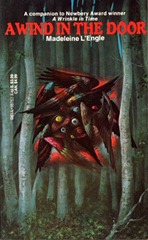
There are dragons in the twins' vegetable garden," announces six-year-old Charles Wallace Murry in the opening sentence of The Wind in the Door. His older sister, Meg, doubts it. She figures he's seen something strange, but dragons—a "dollop of dragons," a "drove of dragons," even a "drive of dragons"—seem highly unlikely. As it turns out, Charles Wallace is right about the dragons—though the sea of eyes (merry eyes, wise eyes, ferocious eyes, kitten eyes, dragon eyes, opening and closing) and wings (in constant motion) is actually a benevolent cherubim (of a singularly plural sort) named Proginoskes who has come to help save Charles Wbllace from a serious illness.

Here we go, the second book in Madeleine L’Engle’s Time Quintet and the second book for Kailana’s challenge. I’ve always felt that A Wrinkle in Time and A Swiftly Tilting Planet are the most well know of L’Engle’s books about Meg Murry, but I look back at this one with great fondness.

There are two reasons for that: Proginoskes the cherubim and mitochondria (and farandolae). All these years later, I found that while not all of the book stood up to an adult reread, those two aspects of it did.

I don’t remember when I first read this book, but it would have been back in my teens. I know that I would have still been in high school, already leaning towards a university degree in science (even without ever having studied biology). I had never come across the word mitochondria before, but already being a scientist at heart, I went straight off to try to find out more. This was not such as easy a task as it would be now, in those long ago, pre-internet days, but I was delighted to discover that mitochondria were indeed real (although I admit to being equally disappointed to find out that farandolae were not).

I also loved Proginoskes – I thought he was described beautifully - and I always particularly liked my cover (shown above) for its attempt to illustrate him, which I always thought did a pretty good of it. Rather like mitochondria, a cherubim (singular, of course) was something I didn’t know much about, but was encouraged to explore further. Many, many years later, I read Faith Hunter’s Bloodring and sequels that features a cherubim, and whatever Hunter’s vision of it, my mental picture was shaped by Progo.

Sure, those are both kind of sentimental reasons for liking a book, but there’s nothing wrong with that. Surely good books should provoke an emotional and even sentimental response?

Meg remained a favourite character, but Charles Wallace was underused in this book – no surprise as he was ill for most of it, but I still noticed the lack. It was great to have Calvin there, but in all honesty, he didn’t do all that much. It was Mr Jenkins who was a surprising star, as a man who had been portrayed as shallow and mean showed that there was more to him than anyone, even himself, would ever have expected.

However, I did feel that A Wind in the Door had dated much more obviously that A Wrinkle in Time had done. There was more pseudo-science in this one, and in the time between 1973 and now, even the general concepts of many of the ideas used by L’Engle have been invalidated by the progress of modern science. We don’t use sound to look at very small things, we use electrons, and we know so much now about the structure of the mitochondrion that L’Engle’s vision, while interesting, is also kind of silly.

The underlying theology was also a lot more prominent this time. In itself, that doesn’t really bother me, as like I’ve said, much of my own is pretty similar. But it was much more to the fore this time to the point that I noticed it, and I suspect other readers may feel the same way. In A Wrinkle in Time I felt she blended the science and theology nicely, but they didn’t mesh quite as well this time.

All the same, I enjoyed my reread, and found that one of my favourite lines of all time came from this book. I’d always known it was in one of the Time Quintet books, but I’d imagined it was A Swiftly Tilting Planet not A Wind in the Door.

Calvin’s eyes met her for a long moment and held her gaze, not speaking, not kything, simply being.

That last phrase, “not speaking, not kything, simply being” is something that I’ve often remembered and wished I could achieve more often in my own life. We get so caught up in all the things we have to do, remember, keep up with, that we forget to simply be. This line has always reminded me of that. I need to try to simply be more often.

One last small love from this book – the comment tossed away in passing that Sandy and Denys will be Teachers one day. I like that. That even the “normal” ones are special too.

So all in all, a pleasant reread, but it didn’t stand the test of time the way A Wrinkle in Time did. It’ll be interest to see my reaction to A Swiftly Tilting Planet which I remember with even more affection than I did this one.

A Wind in the Door
Madeleine L’Engle
Time Quintet, Book 2
7/10
Read: 12-2-10 to 16-2-10

Time Quintet

  1. A Wrinkle in Time
  2. A Wind in the Door
  3. A Swiftly Tilting Planet (Goodreads link)
  4. Many Waters (Goodreads link)
  5. An Acceptable Time (Goodreads link)

Friday, March 12, 2010

Magic Under Glass by Jaclyn Dolamore

Dolamore, Jaclyn - Magic Under Glass (2) From Goodreads.com:

Nimira is a foreign music-hall girl forced to dance for mere pennies. When wealthy sorcerer Hollin Parry hires her to sing with a piano-playing automaton, Nimira believes it is the start of a new and better life. In Parry's world, however, buried secrets are beginning to stir. Unsettling below-stairs rumors swirl about ghosts, a madwoman roaming the halls, and Parry's involvement with a league of sorcerers who torture fairies for sport. Then Nimira discovers the spirit of a fairy gentleman named Erris is trapped inside the clockwork automaton, waiting for someone to break his curse. The two fall into a love that seems hopeless, and breaking the curse becomes a race against time, as not just their love, but the fate of the entire magical world may be in peril.

Dolamore, Jaclyn - Magic Under Glass (1) Before I even start this review, I want to make a comment on the cover. This book, or more accurately this book’s cover, has been causing a stir around the internet. The main character, Nimira, is foreign and dark-skinned, but the book was originally published with the top cover, featuring a white-skinned model. This practice is know as “whitewashing” and there is an excellent post about it at The Book Smugglers which I highly recommend reading.

There was so much fuss that the publisher, Bloomsbury, reprinted the book with the new cover, shown to the left. Personally, I like this one better and the model is a much better representation of Nim. However, the copy I got from the library had the original cover, which is why that one is at the top of the post.

It’s now a month since I read this book (the danger of letting reviews slide) and I’m finding it hard to know what to say about it. It’s not that there’s anything wrong with the book – rather it was a very pleasant read – but I’m not finding lots of memorable things to tell you about. Instead, I’m left with a series of impressions more than a coherent review.

I really liked Nim. She had a bright, positive character that added lovely colour to the novel. There was a real sense of her background and homeland as a bright, sunny, desert kind of place that contrasted beautifully with the more English-like setting of the novel that gave me a feeling of cool and green and something much softer edged. Her situation wasn’t great at the beginning of the novel, but she fully owned that her own actions had brought her to that position and when the offer from Hollin Parry came up, she took the risk and the chance to improve things.

Her interaction with the clockwork automaton and discovery of the spirit inside was nicely done, as were her developing relationships with both Erris and Parry. The plot did grow a little complicated with the discovery of wives in attics and external politics, but it never went out of control.

I found myself a little surprised at the ending. Not that there was anything wrong with it, but that it felt more like a pause than an ending. I had assumed that the book was a standalone, but the resolution suggests there is another book coming. I don’t know for sure if that is the case, but Nim and Erris’s story isn’t finished yet and I hope we do find out what happens to them next.

So all in all, this was a very nice little story. It was a very good debut and I’ll be keeping an eye out to see what Jaclyn Dolamore produces next.

Magic Under Glass
Jaclyn Dolamore
7/10
Read: 5-2-19 to 12-2-10

Tuesday, March 02, 2010

The Sweetness at the Bottom of the Pie by Alan Bradley

Bradley, Alan - Flavia de Luce 01 - The Sweetness at the Bottom of the Pie From Goodreads:

A delightfully dark English mystery, featuring precocious young sleuth Flavia de Luce and her eccentric family.

The summer of 1950 hasn't offered up anything out of the ordinary for eleven-year-old Flavia de Luce: bicycle explorations around the village, keeping tabs on her neighbours, relentless battles with her older sisters, Ophelia and Daphne, and brewing up poisonous concoctions while plotting revenge in their home's abandoned Victorian chemistry lab, which Flavia has claimed for her own.

But then a series of mysterious events gets Flavia's attention: A dead bird is found on the doormat, a postage stamp bizarrely pinned to its beak. A mysterious late-night visitor argues with her aloof father, Colonel de Luce, behind closed doors. And in the early morning Flavia finds a red-headed stranger lying in the cucumber patch and watches him take his dying breath. For Flavia, the summer begins in earnest when murder comes to Buckshaw: "I wish I could say I was afraid, but I wasn't. Quite the contrary. This was by far the most interesting thing that had ever happened to me in my entire life."

Did the stranger die of poisoning? There "was" a piece missing from Mrs. Mullet's custard pie, and none of the de Luces would have dared to eat the awful thing. Or could he have been killed by the family's loyal handyman, Dogger... or by the Colonel himself! At that moment, Flavia commits herself to solving the crime -- even if it means keeping information from the village police, in order to protect her family. But then her father confesses to the crime, for the same reason, and it's up to Flavia to free him of suspicion. Only she has the ingenuity to follow the clues that reveal the victim's identity, and a conspiracy that reaches back into the de Luces' murky past.

This is a book I saw reviewed very positively on several blogs. It sounded like it should be quite delightful. Eccentric English families, strange murders, a Victorian laboratory and its resident eleven year old chemist. What could be better? So I reserved it from the library and started it pretty much right away.

Unfortunately, I think I was expecting too much. While I enjoyed the story, I found it lacking a certain deftness in execution that I had been expecting from other readers’ reviews. Instead, the writing seemed a little stodgy, rather like a sadly undercooked pie crust.

I kept on reading, interested to find out just what was going on, and I’m not in the least sorry that I read the book, but there was still that something missing from the experience. I think, if that delicate, quirky touch had been there, this would have been a brilliant book, filled with strange and delightful characters and happenings.

Instead, I found it all a bit over the top. Flavia was fun, but she was terribly precocious for an eleven year old, and you’ve got to get the characterisation just right for that to work. Sure, I’ve never been to England in the 1950s, but I can’t quite believe the other characters all told Flavia all the secrets they did, or let her traipse around the countryside the way she did. She was never at home and no-one seemed to care. And she just kept on getting in the way. If I had been the policeman in charge, I’d have wanted to lock her in her bedroom and throw away the key.

All her chemical investigations and musings were also a lot of fun, but I do query an eleven year old, even such a precocious one as Flavia, holding quite that much knowledge in her head. (Of course, it didn’t help that this adult who was once a chemist couldn’t really remember any of it, so maybe I was just jealous.)

From the blurbs and reviews I’d read, I had been expecting there to be a lot more solidarity between the sisters than there was which was something I was looking forward to reading, so finding that the girls really didn’t seem to care all that much about each other was rather disappointing.

Please, don’t think this is a bad book, because it wasn’t. But for me, it was an average book and I’d been expecting something spectacular. This was very much a case of having expectations that were way too high and that’s one of the few downsides of reading lots of book blogs. Sometimes, something that works well for others, just doesn’t work as well for me.

All the same, I have the sequel, The Weed that Strings the Hangman’s Bag (aren’t the titles just so cool?), on reserve from the library. I won’t be going into it with such high expectations, which I hope will make the reading experience more enjoyable.

The Sweetness at the Bottom of the Pie
Alan Bradley 
Flavia de Luce, Book 1
7/10
Read: 2-2-10 to 4-2-10

Flavia de Luce

  1. The Sweetness at the Bottom of the Pie
  2. The Weed that Strings the Hangman’s Bag (Goodreads link: Due for release 10-3-10)

Friday, January 15, 2010

Raising Boys by Steve Biddulph

Biddulph, Steve - Raising Boys From Goodreads.com:

From award-winning psychologist Steve Biddulph comes an expanded and updated edition of RAISING BOYS, his international best seller published in 14 countries. His complete guide for parents, educators, and relatives includes chapters on testosterone, sports, and how boys' and girls' brains differ. With gentle humor and proven wisdom, RAISING BOYS focuses on boys' unique developmental needs to help them be happy and healthy at every stage of life.

This isn't what I was planning to read next, but I saw it sitting on the "recently returned" shelf at the library and vaguely remembered hearing about it (although I couldn't remember if what I'd heard was good or bad). So I picked it up and brought it home.

It isn't long, with larger print than normal and an easy style. That make for a quick read - although I admit I skimmed the latter chapters as my son isn't anywhere that old yet and I was feeling pretty tired anyway.

I don't think there's anything mind-bogglingly new here, but it's a solid collection on current theories on raising boys. There is, unsrprisingly given the title and subject, a focus on how boys are different from girls. The author stresses that these differences aren't enormous, but they are there. And because of that, no matter how much gender-equality you try to bring into your child raising, boys are always going to be different from girls.

Biddulph places boys into three age groups that he considers to be times when boys need different types of care and attention. My son is just transitioning from the first (zero to six and needing plenty of motherly attention) to the second (six to fourteen and starting to need more time and attention from dad). I must say, that we are starting to see exactly this progression of needs in our boy, so that gives me some faith in Biddulph's conclusions.

There is a lot of focus on fathers and how important fathers are in developing healthy, mature young men. He is also quick to point out the wonderful job single mothers do, but insists boys also need dependable, healthy male role models. Personally, I would agree with this and I'm very grateful my son has a loving and involved dad.

Because of that, the book didn't have lots of new things to say to me personally, but it was certainly an interesting read and did provide a few ideas to try. Although it isn't his kind of thing, I'm going to try to get my husband to read it before it goes back to the library, even if he just focuses on the six-to-fourteen part.

Raising Boys
Steve Biddulph
7/10
Read: 14-1-10 to 15-1-10

Sunday, January 03, 2010

Mercy Thompson: Homecoming by Patricia Briggs

mercy thompson homecoming Blurb from Goodreads:

Mercy Thompson is a walker, a magical being with the power to transform into a coyote. She lives on the fine line dividing the everyday world from a darker dimension, observing the supernatural community while standing apart.

When Mercy travels to the Tri-Cities of Washington for a job interview, she quickly finds herself smack-dab in the middle of a gang war between rival packs of werewolves. And as if fangs and fur weren’t bad enough, Mercy must deal with the scariest creature of all: her mother, who is convinced that Mercy is making a mess of her life and determined to set her daughter on the right course.

The thrilling adventures of Mercy Thompson–Moon Called, Blood Bound, and Iron Kissed–have topped the New York Times bestseller list. Now Mercy makes her comics debut in an exclusive new story created by Patricia Briggs. Mercy Thompson: Homecoming is sure to please longtime fans and capture new ones with its mix of unforgettable characters and thrilling supernatural intrigue.

Wow, I just read my first graphic novel. And I liked it. So have I been converted to a new book format? Unfortunately, I think the answer to that will be no. I've tried reading some of my husband's graphic novels before today and I've come to the conclusion that my brain just doesn't work in the right way to pick up the entire story in the combination of the images, words and layout. I hadn't realised how important page layout could be in a graphic novel until I tried reading one of Dave's and couldn't follow it at all.

It also doesn't help that I am very much NOT a visual person. I don't easily recognise visual patterns and struggle to remember people's names and faces (however do teachers do it?). I did one of those tests once, where you work out how you best take in information. I was so far onto the read/write scale even the guy giving me the test was surprised. I don't see pictures in my head when I read and I have to keep asking hubby "who's that character?" when we watch a movie, even if I saw them only a scene or two ago. I even frequently have to ask who an actor is and am usually quite surprised to discover it is someone famous whom I should recognise.

So no, I'm not a visual person, and I suspected a visual medium wouldn't work for me. So far, it hasn't.

But I found this book to be nicely straight forward for a graphic novel no-hoper like me. The story mostly moves progressively, and on the whole the flashbacks could be quickly recognised - even if I was a little confused the first time. But all the same, I think the fact I already knew the basics of the tale from backstory in the Mercy Thompson novels helped me a lot. I could say, "oooh, that's Zee" or "hey, there's Uncle Mike" because I already knew the characters. If it had just been a bunch of drawings and a sparsely-worded story I didn't know (strongly read/write, remember, I need words much more than I need pictures) then I think I would have struggled. Maybe that's why I struggled when trying to read hubby's graphic novels. I was going in cold and didn't have a clue.

So, after all those caveats, I'll say that I liked the book. I liked seeing Mercy come to the Tri-Cities. (Say, is that three cities that have merged or just once city called Tri-Cities? This New Zealander has no idea.) I like the way the person she came there to try to be was totally different from the one she actually turned into. It was nice to see her meet already-established characters like Zee and Stefan (and Tad too) and their first meeting makes her relationship with Adam in the very first book, where she goes out of her way to annoy him when she can, make lovely sense.

The drawings seemed good to me (don't forget, I'm the total and absolute opposite of an expert) and I could usually remember which character was which, something that isn't always the case with me. The book was beautifully made with slick, glossy pages and lovely production values. I suspect it hasn't been borrowed too many times as it hasn't started to lose that shine yet.

Would I read more graphic novels about Mercy? Yes, I would. But I admit that I would be reading them for more story about Mercy (or about Anna and Charles if they make it to comic format) than because it was a graphic novel in general.

As I said at the beginning, my brain just doesn't seem to "get" graphic novels and I've got way more than enough prose novels to keep me happy for a very long time yet. Like, say, the new Mercy book coming out in March. But if you are a Patricia Briggs fan anyway, give it a try. If you are a Patricia Briggs fan and a graphic novel fan, definitely give it a try.

I'd be interested to hear what regular graphic novel readers thought of it. Does the fact it was simple and linear enough for me to follow mean it was too easy for you? I came to it totally as a prose book reader with visual issues so I suspect I don't count as the target audience in any way.

Mercy Thompson: Homecoming
Patricia Briggs
Mercy Thompson, Book 0
7/10
Read: 3-1-10 to 3-1-10

Mercy Thompson Series

  1. Homecoming
  2. Moon Called (Goodreads link)
  3. Blood Bound
  4. Iron Kissed
  5. Bone Crossed
  6. Silver Borne (Goodreads link: Due for release 30-3-10)

Friday, January 01, 2010

Earth’s Magic – Pamela F. Service

earth's magic Blurb from Goodreads.com:

The exciting conclusion to this futuristic Arthurian trilogy!

Heather and Earl (called Merlin the wizard by most) are working with King Arthur to unite Britain following a terrible nuclear devastation. Merlin’s sworn enemy, Morgan LeFay, is also organizing her forces, hoping to take over the world once and for all. Earth’s only hope is for Earl to find his father, who has been trapped in an enchantment for two thousand years. The problem is, Earl doesn’t know where to look, and worse, doesn’t even know what form the enchantment takes. Time is running out and Earl and Heather must solve the ancient mystery and return with the key to the Earth’s Magic.

Traveling to one of the origins of humanity, the ancient kingdom of Kush, Merlin must decipher the key before the summer solstice when a great battle will be waged to decide the future of the earth.
With a terrific heroine and an exciting nod to many cultures and legends, this riveting conclusion to Pamela Service’s tightly crafted and ingenious Arthurian trilogy is an exciting homage to the great adventure classics, as well as a marvelous addition to the Arthurian legend.

I first discovered this series long ago when it was only two books (which have now been reprinted in a single volume). I was proabaly a young adult or close to it at the time and I was delighted last year when Pamela Service picked up the series again and continued it.

Now we have the last volume of the series. This one focuses primarily on Merlin, with Heather as the secondary character. Welly has much more of a bit part, but he had found himself and his future by the end of the previous book and he fitted nicely into his smaller role in this one.

Not only do we have the science fiction-ish trappings of the post-nuclear world and mutated creatures, but in the last two books the remergence of a new kind of magic has become more and more prevalent. In fact, the series in its newly published form is now called the "New Magic" trilogy. And really that is what this book is all about as Merlin strives to return some kind of balance between good and evil in the world so that the creatures of the normal world and the various otherworlds can live together.

I liked this series and I was nicely happy with its conclusion. The concept of how humanity created the otherworlds and their inhabitants and then forget them was nicely done. And I loved the idea that stopping believing in someone doesn't stop them exisitng.

As Osiris says to Merlin, "A child is created by his parents, right? But when the parents die, does the child just fade away? No. He may change as he grows, and he will have been molded by his parents. But he exists and will until his natural time is up."

The future of the world is going to be very interesting and I'm just sorry that there's a good chance we'll never see the characters living in it. That's a difficulty with books where there is a big problem to be solved to create a new future. They tend to end at the point where that future is created. I want to see what living in it is like, but unfortunately, unless more troubles arise, there generally isn't a suitable story to tell after that point. I'm not a great fan of short stories, but I think this is a good case for them as it is a way to give us a sneak peek at the result of all the characters' hard work. I'd like to get to see what Service's world is looking like a few years down the track and I hope we'll get to do so.

This is a good little series. Yes, it's technically for older children; probably those approaching the YA range rather than young adults themselves. But it's still a fun read for adults and I'm glad I've read them. They'll be staying on my shelves (and my computer as I have the latter two as ebooks) and I suspect I'll be rereading them again a few years down the track.

I'm only sorry that combining the two original books means that we've lost the wonderful title of the first - Winter of Magic's Return - as it is combined with the more prosaic Tomorrow's Magic. Oh well, it is the content that matters most. Take the time to travel 500 years into the future, meet Merlin and King Arthur in guises you've probably never seen before, and enjoy a story about creating a new world out of the ruins of the old.

Earth’s Magic
Pamela F. Service
New Magic Trilogy, Book 3
7/10
Read: 31-12-09 to 1-1-10

New Magic Trilogy:

  1. Tomorrow’s Magic (originally published in two volumes as Winter of Magic’s Return and Tomorrow’s Magic)
  2. Yesterday’s Magic
  3. Earth’s Magic

Wednesday, October 07, 2009

I finished a challenge!

mckillipchallenge_300btn Wow, I did it! I actually completed a challenge. The other day I finished reading Patricia A. McKillip’s Harrowing the Dragon, a collection of short stories. In doing so, I read my third book of hers for the year and completed Lennth’s challenge. My updated challenge post is here.

c14278 I have to admit this was far from my favourite on McKillip’s works. I think she’s better at full length novels than short stories.

I usually love McKillip, but a lot of these stories failed to completely satisfy. I think a lot of the problem is that the endings tended to feel weak to me; the stories built beautifully, the writing was lovely and then they just kind of ended. My favourites were "The Stranger" and "The Lion and the Lark" and I think part of that is because the endings were stronger. But I'm left with the feeling that McKillip writes better at the longer length than the shorter one.

All the same, I enjoyed the experience. I’m not really one for anthologies full of stories by different authors, but reading this collection by McKillip and Dreams Underfoot by Charles de Lint earlier this year I’ve discovered that I’m more likely to enjoy a collection by a favourite author where I know I already enjoy their world(s) and writing style.

Harrowing the Dragon
Patricia A. McKillip
7/10

Qualifies for: 100+ Reading Challenge, Patricia A. McKillip Challenge, eBook Reading Challenge

I’ve actually managed a few book comments over on my GoodReads entries lately, so I shall endeavour to add this to the blog over the next few weeks. It’s school holidays here and having Marcus at home for two weeks solid (well 1½ so far) has really knocked me over.

Tuesday, March 24, 2009

The Diamond of Darkhold – Jeanne duPrau

duPrau, Jeanne - The Diamond of Darkhold In The Diamond of Darkhold, Jeanne duPrau goes back to her original time frame as established in The City of Ember and continues the tale of Lina, Doon and the people of Ember and Sparks as they forge a new future together.

When a Roamer visits Sparks, Doon and Lina end up in possession of the last eight pages of a book (or rather, by the sound of it a booklet) that appears to have been intended for the people of Ember when they left their city. Lina and Doon decide to go back to Ember and try to find the “diamond” that the book is describing. They find their city changed and even inhabited, meaning finding the diamond hidden there will be harder than they expected.

This was a solid end to the series. I personally didn’t find anything deeper in it than an adventure that would set the characters (and their children and children’s children and… etc etc) up for a new and hopefully better future. Like The Prophet of Yonwood before it, the book has an epilogue tacked on the end that is essentially a list of “what happened after” that, while not good storytelling, was a nice way to let us know where that new future is going to lead. (Although I did think the plot point of the “travelling star” was totally unnecessary and a waste of space – as was its setup back in Prophet.)

The atmosphere of abandoned Ember was nicely done – a homecoming that isn’t a homecoming to a place that is no longer familiar – and it was nice that Lina and Doon got to say goodbye properly this time. It was also nice to see some of the other children from both Sparks and Ember working together, showing that the groups are slowly beginning to merge.

I know the book is written for children/young adults and, as such, should have adventurous and brave protagonists, but I have to say, from a parent’s point of view, that if Lina and Doon were my kids they’d have turned me grey long before now. Enough with the running off at the crack of dawn and leaving messages hidden so they won’t be found until the two of them are well on their way. As a kid myself – and maybe even right up to before I had a kid of my own – I probably took such things in my stride and didn’t notice, but these days I’m always wondering where the parents are or throwing up a silent cheer if they are present and useful characters.

All the same, like I said, this is a solid end to the series and it has been a satisfying journey. I like a good post-apocalyptic tale and while I don’t think this series has the depth of the other YA post-apocalyptic series I’m reading (Isobelle Carmody’s Obernewtyn books), I enjoyed it all the same.

The Diamond of Darkhold
Jeanne duPrau
The Books of Ember, Book 4
7/10

Qualifies for: 100+ Reading Challenge, Support Your Local Library Reading Challenge, Young Adult Reading Challenge

The Books of Ember:

  1. The City of Ember
  2. The People of Sparks
  3. The Prophet of Yonwood
  4. The Diamond of Darkhold

Thursday, March 19, 2009

Dewey: The Small-Town Library Cat Who Touched the World – Vicki Myron

Myron, Vicki - Dewey The Small-Town Library Cat Who Touched the World

This book was all over book blogs last year (which may even be when I put a reserve on it at the library as it took a lot of time to get down to me through the holds). I got it from the library at the beginning of the month and settled down to something rare for me – a non-fiction book.

On a freezing January morning, someone put a tiny kitten into the book returns slot at the library in Spencer, Iowa. The librarians rescued the frozen cat, quickly fell in love with him and adopted him. Dewey Readmore Books, as he was eventually named, because the library cat at Spencer Library and by the time he died at the grand old age of 19, was not only famous locally, but all around the world. This is his story, coupled with some of the story of Spencer itself and of head librarian Vicki Myron, who was Dewey’s “human mum”.

While this isn’t the best written book in the world, it’s a really lovely story about a lovely cat, and if you’re a cat lover (not to mention a bibliophile) you’re sure to enjoy it. It’s a little biased – Vicki Myron clearly loved Dewey very much – but a delightful tale all the same. It also features some interesting history about the American mid-West in the 20th century as well as some of Myron’s own history that puts some parts of the story into context.

I admit I’m not convinced Dewey was as telepathic as Myron makes out, but otherwise I was enchanted by him. I’d love to walk into my library and find a cat waiting to greet me. Dewey’s fame was a little strange but also understandable as it sounds like he was a character and I can readily see his story getting passed on and on in an ever-increasing circle (or probably less perfect shape). It was good to see that New Zealand was included in the places around the world where Dewey had fans. As much as I’m generally reluctant to join in with the “in thing”, I rather suspect I would have been a fan too.

Like I said, if you like books and you like cats, give this book a read. It’s a lovely story of a remarkable – and totally adorable – cat.

Dewey: The Small-Town Library Cat Who Touched the World
Vicki Myron
7/10

Qualifies for: 100+ Reading Challenge, Support Your Local Library Reading Challenge

Saturday, February 28, 2009

Angel’s Pawn – Nalini Singh

Singh, Nalini - Angel's Pawn This little story was published as an ebook exclusive to tie-in with the imminent (3rd March) release of Singh’s first book in the new Guild Hunter series, Angel’s Blood. Being the completist kind of person that I am, of course I bought it and read it. Now I’m waiting for the actual book to arrive.

Ashwini is a Guild Hunter. In this alternative Earth, that means she tracks down rogue vampires to return to their masters, the angels. Ash has tracked Cajun vampire Janvier three times so far, but he has always managed to fix his problems before she gets a chance to capture him. Now, she finds herself asking him for help as she gets caught up in a dispute between two vampire factions that their ruling angel wants resolved without getting involved himself.

This is only a little story, introducing the set-up of the world Singh has created. She has already proved herself an excellent world-builder with her Psy/Changeling series and it looks like she is going to have done it again with this series. Here we find out that angels are powerful and intimidating creatures who inspire fear rather than awe and like to play often malicious games. Whatever the background of these angels, they are not the ones of religious lore in our world – or not Western Christian lore anyway. I don’t know enough about other religions to comment on those. In this novella, we learn that the angel in it, Nazarach, is 700 years old. The implication is that other angels are older, but in terms of the history of the world, that’s still not all that old. It makes me wonder where the angels came from. I am hoping that as the series and the world develop we’ll learn more.

Humans petition the angels to be Made into vampires and only a few are accepted. Vampires offer the angels their first 100 years in service and the hunters track down those that break their contracts. It seems that century is rarely pleasant, but the indication so far (and it’s a small sample of one short story and the first three chapters of Angel’s Blood that I’ve read) is that vampires come in a variety of types, probably indicative of who and what they were in life. Certainly, Janiver is an appealing character, if clearly far from perfect. I enjoyed him in this story and I can certainly understand why Ash is attracted to him. The other vampires in the story range from mean to petulant, and petty to scheming. Discovering whether there will be more like Janiver or if he’s an aberration will have to wait on the full series.

Ash is a well-rounded character, intact with a harsh past that is explained in a few moment’s of Ash’s remembrance rather than expounded on in detail, which is perfect for this kind of story. Kudos to Singh for having faith in her own story-telling ability (which she has already proved is excellent) rather than belabouring the point. In a pleasant change from many stories, Ash has already made a certain kind of peace with her past and chose to accept she isn’t exactly ordinary. She has made a virtue of her differences and if some things (like meeting an angel whose very house as well as his person is seeped in the pain caused by his past actions) are difficult to manage, she finds a way to do it.

I honestly don’t know if this is the idea start for Singh’s new series. I think it helped me to have already read the teaser chapters of Angel’s Blood, but it is certainly a good little story and well worth reading. All the same, coming from that Western Christian background I mentioned earlier, I find the concept of angels that are all about pain and power and cruelty a little uncomfortable. How well Singh makes it work for me is still to be discovered. I guess Angel’s Blood will be the true test, although those first three chapters suggest its angel may be an exception rather than the rule.

Angel’s Pawn
Nalini Singh
Guild Hunter short story
7/10

Guild Hunter:

  1. Angel’s Pawn
  2. Angel’s Blood (March 2009)

Tuesday, February 17, 2009

Starcross by Philip Reeve

Reeve, Philip - Starcross

After thoroughly enjoying Larklight, I immediately requested the next book from the library and made a suggestion to buy the third, since it wasn’t yet in their catalogue. Happily, they took up my suggestion (so far, I think they’ve bought nearly everything I’ve suggested) so I have now read Starcoss and have the third volume, Mothstorm sitting on the shelf in the bedroom, waiting for me to get to it.

In this adventure, Art, Myrtle and their mother leave Larklight while it is getting a top to bottom (or, as Art points out, top to top, since it has no particular up or down) refit. They are invited to visit Starcross, a new holiday resort in the asteroid belt. There, they discover Jack Havoc undercover, mysterious goings on, time travel, sea bathing and nefarious top hats. Soon, Art (and Myrtle of course) are fighting another threatening invasion, rescuing friends and family and, naturally, saving the great British Solar Empire.

This was another light, fun, and slightly crazy adventure. Art’s narration remains a lot of fun, Cross’s steampunk-y world is still full of clever and sometimes sly ideas and the illustrations are again lovely. Again, there are silly throw away lines - my favourite was about locations in the asteroid belt:

…and Abnegation, which was woven out of brown string by Presbyterians.

Larklight’s obvious pop-culture reference was from The War of the Worlds. This one from Starcross should be even more recognisable:

“He dreamed of founding a Rebel Alliance which would strike at your Empire from a hidden base…”

All the same, I didn’t enjoy Starcross quite as much as I did Larklight. I’m not sure why, but it didn’t have quite as much sparkle. Maybe it was that the world wasn’t so new to me, or maybe it was the story itself. While the Moobs were a neat idea, I’m personally afraid of spiders, which may be a factor in why I found the Old Ones in the previous book to be a much more successful enemy. Or maybe it’s just that, even in a book that isn’t supposed to be taken seriously, I simply couldn’t take evil top hats as a valid villain. (No, they’re not actually top hats, but I’m not going to spoil it.)

That said, I still enjoyed reading it a lot and I’m looking forward to reading Mothstorm. If you haven’t read anything in this series by Philip Reeve before, start with Larklight, as their are spoilers in this book for the previous one, especially relating to Art and Myrtle’s mother. Otherwise, settle back for another fun adventure and spend a pleasant afternoon or two adventuring across the solar system.

Starcross
Philip Reeve
Larklight, Book 2
7/10

Qualifies for: 100+ Reading Challenge, Support Your Local Library Reading Challenge

Larklight:

  1. Larklight
  2. Starcross
  3. Mothstorm

Sunday, February 08, 2009

Princess of the Midnight Ball by Jessica Day George

George, Jessica Day - Princess of the Midnight Ball

I have admitted before that I’m shallow. I find myself forced to admit it again – it was the cover that attracted me to this book. I saw it in the ‘upcoming releases’ section at Fantastic Fiction and the pretty cover encouraged me to check out the blurb. While it was actually the blurb that persuaded me to track down the book, I wouldn’t have read the blurb without the cover, so in the end, the credit for my enjoyment (because I did enjoy it) has to go to the cover.

Princess of the Midnight Ball retells the story of the twelve dancing princesses whose father the king is driven to distraction by the way their dancing shoes are worn to pieces every night and they refuse to tell him why. George’s telling doesn’t vary into new territory, in that she sticks to the basic, familiar tale, but she breathes life into the characters in a way that makes you care about what happens to them and want them to triumph over the curse that is woven around the princesses. She also provides a backstory for why the girls must dance for the King Under Stone every night that is perfectly reasonable and fits with the kingdom and characters she has borrowed and/or created.

Galen is a young soldier, returning from a war that, finally after twelve long years, Westfalin has won at great cost. With all his family dead, he makes his way to the capital city of Burch and the aunt and uncle he has never met. Along the road he meets an old woman and takes the time to share his meagre supplies with her. In return, she gives him a cloak of invisibility, some balls of wool and words of advice. Puzzled by the gift, he continues on his way. He finds his aunt and uncle and goes to work for his uncle, who is the king’s gardener. In the palace gardens, he meets Princess Rose, the eldest of the kings twelve daughters and gets caught up in the mystery of why the princesses wear out pairs of dancing slippers every night.

Galen is an endearing hero and his adventures as he tries to break the princesses’ curse are deftly told. The language has a light touch that matches the fairy tale setting of the book. There are moments of humour and of great tension, especially at the end as Galen and the princesses flee from the underground kingdom. Rose and her sisters are well drawn, and if I got a bit confused about which sister was which, there were twelve of them so I think I can be forgiven. The littlest princess, who has been forced to dance since she could walk, is a lovely character and her interactions with Galen are lovely.

I enjoyed the king too, a character who can be poorly treated in the tale. He’s a loving father trying desperately to help his daughters but not understanding the smallest thing about what is happening to them. His dead wife is a surprisingly strong character considering she has been gone for years; but she is the one who set the curse in motion (not a spoiler as we learn this in the prologue) and so her influence hangs over the entire story. But even she is misguided rather more than anything else, and we come to understand her and her actions by the end of the tale.

The magic is subtle, not spells and enchantments, but something quieter and more integral to the world itself. Galen knits, and his knitting is hugely important to the plot and it is herbs from the garden that protect him from the King Under Stone’s enchantment that sends everyone around the princesses to sleep as they ready for his Midnight Ball. I enjoyed this, as it fitted with the delicate touch of the prose and the tale’s feeling of gentle innocence.

This is a lovely little book, easy to read and filled with pleasant characters whose lives it is a pleasure to visit for a while. I’m glad I got seduced by the cover, as I enjoyed the story it was advertising.

Princess of the Midnight Ball
Jessica Day George
7/10

Qualifies for: 100+ Reading Challenge, Young Adult Reading Challenge, Support Your Local Library Reading Challenge

Tuesday, January 27, 2009

The Dreaming Place by Charles de Lint

de Lint, Charles - The Dreaming Place

After thoroughly enjoying Dreams Underfoot, Charles de Lint’s first book of Newford short stories, I wanted to keep reading through the series. According to the FAQ on his site, the next two were horror. I don’t do horror, so I jumped those and came to The Dreaming Place. This is a YA title that features sixteen year old cousins and none of the myriad characters I met in Dreams Underfoot, so it was a little different from what I was expecting.

Nina, an everyday, normal teenager is convinced her Goth cousin, Ash, is trying to put a spell on her. Something is making her dream she is trapped inside animals and Ashley is always reading occult books and causing trouble with her attitude. But Ash is simply trying to deal with the death of her mother and subsequent rejection by her father that sent her to live with her aunt, uncle and cousin three years ago. When she learns a winter spirit, or manitou, is hunting Nina, despite their differences, she does her best to help. If she is reluctant at first, she learns her strength and finds some self-worth and healing in the process.

I wasn’t as taken with this book as I was with Dreams Underfoot. It’s a good, solid YA title that is well worth reading, but it didn’t have that extra something the previous book did. I don’t really think it is a YA vs. adult novel thing, as I enjoy both kinds of books and one of my favourite books of all time, The Changeling Sea by Patricia A. McKillip is YA. However, for all that this was a full length novel rather than short stories, Nina and Ash both remained ciphers to a degree, and this meant I was interested in their tale but not mesmerised by it. I was much more enchanted by the adults in Dreams Underfoot.

The chapters alternate between Nina’s POV and Ash’s, yet I felt the book was more about Ash than Nina. It is Nina that is on a search for her totem animal (even if it was instigated by the manitou and not NIna herself), but it is Ash that goes on a voyage of self-discovery through the Otherworld. Nina finds her totem animal, Ash finds herself and the book comes to a satisfactory conclusion.

I feel like I’m damning the book with faint praise here, but I find I really don’t have much to say about it. It certainly isn’t a bad book – I don’t feel the need to go into details about what is wrong with it, because there isn’t really anything wrong with it. I just don’t feel inspired to jump up and down and insist this is an amazing must-read either. It’s simply a book, average or a little above that is worth the time to read, but isn’t something to rave about.

The Dreaming Place
Charles de Lint
Newford Novels, Book 4
7/10

Qualifies for: 100+ Reading Challenge, Young Adult Reading Challenge